By: Ligia María
Spanish version below. Versión en Español, abajo.
The Shift of the Ages film is a true and authentic story of the Maya, the Mayan Calendar, 2012 and the turbulent times in which we are living. Compelling and timely, this story is told through living Grand Elder, Wandering Wolf, also known as Don Alejandro Cirilo Perez Oxlaj.

Don Alejandro Cirilo Pérez Oxlaj
The Story
The Mayan Council of Indigenous Elders in Guatemala has a profound story, shared by their leader, Wandering Wolf. As the protagonist of the Shift of the Ages, Wandering Wolf is known as “the voice of the jungle and the messenger of the Maya.” The film is the Maya’s first official discourse to the world, and sharing this story with humanity is Wandering Wolf’s destiny.
Wandering Wolf’s journey mirrors each human being’s quest to regain authority for the fulfillment of both individual and collective destinies, as we navigate these rapidly changing and shifting times.
The Mayan Calendar Connection
The famous Mayan Long Count Calendar, expected by many to end on December 21st 2012, has prompted unnecessary fear, because people are unclear of the calendar’s meaning. Wandering Wolf helps clarify these and other misunderstandings in Shift of the Ages. He says that according to Maya prophecy, we have entered a unique time-period, a “change of Suns” during which humanity traverses a significant evolutionary shift. Wandering Wolf and many Mayan Elders believe it is crucial for humanity to prepare for this transition.
Why Now?
The Maya consider themselves the Keepers of Time, and prophesize that the new “Sun” is about to dawn. Wandering Wolf tells us that in order to facilitate the transition, we must collectively learn to cooperate, to treat each other, the earth, and its life with dignity and respect. As he suggests, “We are one, like the fingers of one hand.” Wandering Wolf admonishes humanity to immediately stop wars, pollution, discrimination and avarice in order to avoid further tumult.
Indigenous Protesters Blockading Mine Owned by Goldcorp Assaulted, Taken Hostage in Guatemala
By: Ligia María
Original version, Spanish translation below
By Ahni
March 1, 2011. On February 28, 2011, approximately 50 Indigenous men and women from Mayan communities affected by Goldcorp’s Marlin Gold mine in San Marcos, Guatemala, were attacked and taken hostage by a group of individuals said to have “strong ties” to the Vancouver-based mining company.

Traducción al Español, abajo
For Immediate Release
San Miguel Ixtahuacan, San Marcos, Guatemala, February 28, 2011.
by San Miguel Ixtahuacan Defense Front
TO THE NATIONAL AND INTERNATIONAL COMMUNITY
THE SAN MIGUEL IXTAHUACAN DEFENSE FRONT
REPORTS
FIRST: On February 28, 2011, communities took action to pressure the government of Guatemala to carry out the Precautionary Measures MC-260-07 granted by the Inter-American Commission on Human Rights, which include the temporary suspension of the Marlin mine. The action consisted in peacefully blocking the main routes used by the company* in a way that respects the Constitution of our country, in which we have the right to protest.
SECOND: When the blockade began, a group of approximately 20 people assaulted Miguel Bamaca, despite the fact that the Presidential Human Rights Commission has granted him protectiv measures. Miguel Bamaca was beaten mercilessly by a family known as the Mejia family, together with neighbours who work for the company. These people have strong ties to the company and also to illegal business activities. This incident occurred at four thirty in the afternoon in a location known as Siete Platos.
THIRD: On the way back, near the community of San Jose Ixcaniche, approximately 70 members of this community intercepted the bus and began to assault various people who were travelling in the bus. Among them, our comrade Aniseto Lopez and others were beaten without being able to defend themselves. The attackers came armed with guns, stones, knives, sticks, and other weapons. Right now, approximately 50 people are kidnapped and being threatened by the community of San Jose Ixcaniche and the Mejia family.
By: Ligia María
Original version, Spanish translation below
By Danilo Valladares
Guatemala City, Dec 12, 2010 (IPS) – Nearly three years into President Álvaro Colom’s four-year term, Guatemala’s indigenous people have seen little improvement in their lives — and they represent approximately half the country’s population.

Traducción al Español, abajo
“The situation of the native peoples may be even worse than before. Poverty has increased, the quality of education is very poor, and there is no intercultural perspective in health services,” Eduardo Sacayón, director of the Interethnic Studies Institute at Guatemala’s University of San Carlos, told IPS.
The social-democratic President Colom promised when he was sworn in, Jan. 14, 2008, that he would govern “with a Maya face,” in favour of the poor and excluded. “Today is the beginning of privileges for the poor, today is the beginning of privileges for those without opportunities,” he said at the time.
But Sacayón says the reality is quite different: “It is a structural and historic issue of always seeing what is indigenous as something that is not worth the effort, that has no value, or is a burden to the country.”
According to official statistics, 40 percent of the Guatemalan population is indigenous, and include Maya, Garífuna and Xinca peoples. Though they themselves claim that more than 60 percent of Guatemala’s 14 million inhabitants are indigenous.
“Since the arrival of the Spaniards (in the late 15th century), Guatemalan society has had the idea that what is indigenous has no merit, and only what is Western has value. That concept is nothing more than a racist and discriminatory viewpoint, but it is repeated through the governments, the political parties and even the media,” Sacayón said.
Guatemala adopts indigenous rights into Constitution
By: Ligia María
Guatemala March 4, 2010. The Constitutional Court of Guatemala has adopted ILO Convention 169 on indigenous and tribal peoples into the country’s Constitution.
Guatemala ratified Convention 169, the only international law for tribal peoples, in 1996. It is one of twenty countries to have ratified the Convention, which recognizes tribal peoples’ land rights and says they should be consulted prior to the approval of any projects on their lands.
The Court ruled that all the rights provided for in the Convention have constitutional status, which means that the State must consult with indigenous people before approving any mining and hydroelectric licenses, laws and regulations in their territories.
The ruling is a success for Guatemala’s indigenous peoples, the Maya, Garifuna and Xinca, giving them greater control over projects that affect them. It is also significant for tribal peoples across the world, showing the growing strength of Convention 169.
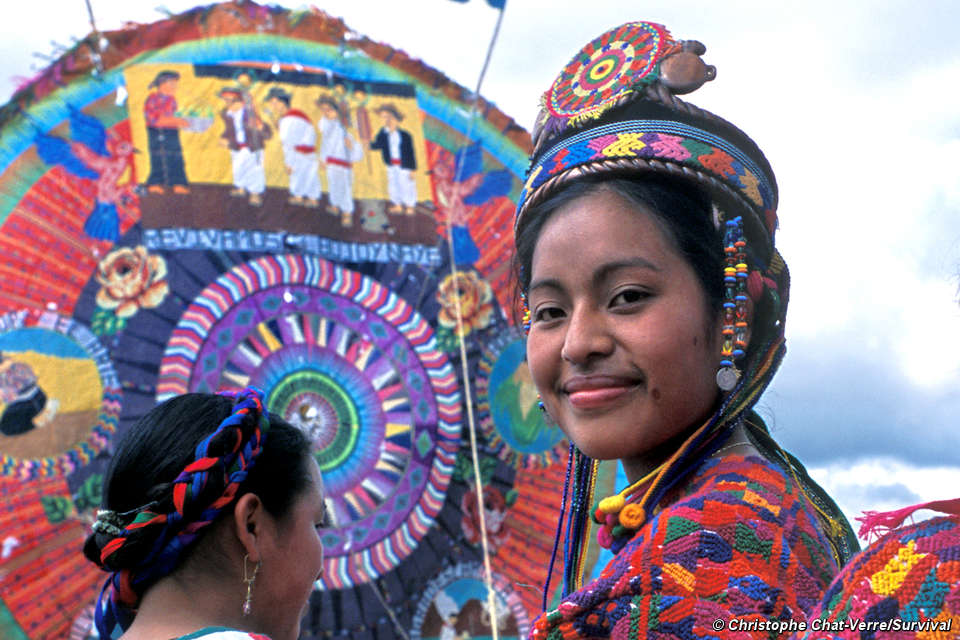
A Mayan woman during a kite festival at Santiago Sacatepequez, Guatemala
International Day of the Indigenous Pueblos
By: Ligia María
August 9, 2010. Rural organizations in Guatemala today commemorate the International Day of the Indigenous Pueblos. These organizations maintain that despite President Alvaro Colom’s claim that his government has “an indigenous face,” there have been few, if any, advances in human rights initiatives for the indigenous communities.
Translated from Spanish; original version below.

Versión original en Español, abajo
Indigenous leaders say that Mayan pueblos and communities are abandoned; roads have deteriorated; schools are neglected; the ratio of teachers to students remains untenable; water is unavailable; and destruction caused by hurricane Agatha has not been addressed.
Juan Tiney, representing the National Indigenous and Rural Committee (CONIC), states that: “In spite of the laws, this government does not want to support the indigenous communities because this represents a threat for the businessman. In the meantime, the indigenous pueblos are starving to death, discriminated against and incriminated for defending their lands.”
Otila Lux, Member of Parliament, serves on the Commission of Indigenous Pueblos of the Congress of the Republic. She states that: “The living [conditions] for the indigenous pueblos in this country are [catastrophic].”
Ricardo Cajas, representing the Committee of Mayan Organizations in Guatemala (COMG) believes that, “…there is no progress because the nation of Guatemala is not interested in moving beyond its colonialist, liberal, or neoliberal policies, blocking the exercise of collective rights, not only for the indigenous pueblos, but for the entire population.”
The indigenous organizations concluded by declaring that this government has done little for either the Mayan population or any other. It is not a social democracy.
Commemoration of the International Day of Indigenous Pueblos
By: Ligia María
August 9, 2010, Morelia, Mexico. Over 50 Million indigenous people from native pueblos call Latin America home. The majority lives in Mexico, Guatemala, Bolivia, Peru and Ecuador.
Translated from Spanish; original version below.

Versión original en Español, abajo
On Monday, August 9, 2010, according to an official of the United Nations, Latin American governments were asked to improve their efforts to meet the criteria of the Declaration of the United Nations regarding the Rights of the Native Pueblos of America.
“It’s urgent to increase efforts to accomplish the principles and rights contained in the Declaration (approved for 143 countries in September, 2007),” said Carmen Rosa Villa, representing the United Nations’ Central American High Commission for Human Rights.
According to Villa, it is “essential” to guarantee the rights of the Indigenous Pueblos to participate in the decisions that affect them; to “make space for inter-cultural dialogue between the States and the Native Pueblos.”
For this reason, Villa called on the countries of the region to fulfill the Declaration in offering respect, protection and human rights for those ethnic groups.
The United Nations Commissioner for Human Rights, Navy Pillay, sees a “long road” between the Declaration’s statement of principles and its implementation for the pueblos of the region. He cites: “continued suffering discrimination, marginalization, extreme poverty, and exclusion from the decision-making process.”
Indigenous Leaders Claim Discrimination and Racism Persist
By: Ligia María
Guatemala, August 8, 2010. In Guatemala, where Mayan pueblos have little access to politics, education or legal recourse, indigenous leaders claim that discrimination and racism persist.
Translated from Spanish; original version below.

Rigoberta Menchú
Versión original en Español, abajo
According to Nobel Peace Prize winner, Rigoberta Menchu, “…the problem is still there, although it’s been discussed for 30 years. Politics are needed, because the discrimination continues, though stealthily.”
Menchu indicates that the plight of indigenous people stems from a lack of pluralism within the government: “There is no estate (representation) in Guatemala for the indigenous pueblos. For instance, if we go to Ixil (northwestern Guatemala), the Estate (State) reduced the participation to one indigenous representative.” In the opinion of the Nobel Peace Prize winner, the Guatemalan Mayan pueblos report only slight political progress after decades of conflict.
“Although many indigenous citizens from the pueblos qualify for Public Administration positions, the State maintains a colonialist…environment,” opines Menchu.
Isabel Cipriano, leader of the Mayan Women’s Association, “MOLOJ,” believes that the disease of racism motivates the manipulative use of indigenous peoples and pueblos as de-humanized “ornaments.”
After “Agatha” storm, at least one hundred of Indigenous Communities has been affected in Guatemala.
By: Ligia María
Translated from Spanish; original version below.

Versión original en Español, abajo
Guatemala, Guatemala, June 3rd, 2010. At least one hundred of Indigenous Communities with high levels of poverty have been affected for “Agatha” Storm; unfortunately they have not received help. The population starts to feel food shortage, because they have not been attended, denounced the Peasant Unity Counsel (CUC).
These populations, most of them placed in regions faraway at the west of Guatemala, report fields of corn and beans being destroyed and big losses.
The executive Secretary of the Coordination of Disasters Prevention, Alejandro Maldonado, informed that after the rains got less, by air traffic started, bringing food and sheets for more than one hundred thousand of the victims of this natural disaster, recognizing that because of the vial roads damage around the country the transportation were really hard and slow.
After the storm, members of Help Institutions have started seeking for human rests, under tons and tons of mud, caused by the mud slides. So far there are 156 death people, one hundred missing people, 24 thousand houses damaged, and 16 damaged bridges.
On the meantime, International Assistance started to help Guatemala; Spain Government gave $187,000 destined to help the damaged population of Sololá, the West area of Guatemala.
Argentina: The Indigenous Face.
By: Ligia María
Translated from Spanish; original version below.

Versión original en Español, abajo
Servindi, Argentina, May 22nd, 2010. The mystic Square of May, where noble events happened; like “The March of the Mothers and Grandmothers of May” honoring the missing persons at the military dictatorship period, was the scenario of one crowded march of Native Pueblos, reclaiming for the very first time in its history, the re-foundation of Argentina as a Plurinational Country like Bolivia or Ecuador.
There, the children of “Pachamama”placed a flag with the colors of an “Indigenous Argentina”, celebrating the bicentenary of that Country, stressing the future coming of a new period of time in the historical process of this South Country, said the Indigenous leaders.
“Walking into the truth, through a Plurinational State” Was the consign of the march, that happened on May 12, which its goal was not only the restitution of an ancestral land and other rights, but the re-foundation of the Country into a Plurinational State.
Thousand of Indigenous people, representing the 30 Indigenous Pueblos in Argentina, wearing their multi-color ponchos and typical clothing, which designs they kept through more than 5 centuries, walked almost two thousand kilometers in this National March of the Native Pueblos, until they got together at Buenos Aires from the four cardinal points.
By: Ligia María
Translated from Spanish; original version below.

Mayan Elder Cirilo Perez
Versión original en Español, abajo
Guatemala, February 22 nd, 2010. Religious Ceremonies and cultural acts, stressed this Monday the beginning of the year 5126 of the Mayan calendar, which will be ruled by Kej (Deer) prognosticating ability and strength in order to find a balance between physic, mental, spiritual and emotional energies of their authorities.
On the Maya Cosmo vision, each year brings an specific energy a “charger”, for this year it is the Deer; according with the specialist Emilio Ajquejay, of Cultural Ministry, who thinks that this year will be a fast year and “the authorities of the world will be strengthen”.
The deer symbolize also the four cosmic points that strength the energies, that is why it is going to strength “the energies of the governors”, explained Ajquejay.
In the meantime, Indigenous leader María Quezada said that because it is an animal of “four legs” the Deer emphasized the balancing between the four energies: physic, mental, spiritual and emotional.
“In that order, the leaders are in harmony, they will be able to unify. Otherwise, they will divide” expressed Quezada.
 Maya News