Guatemala celebrates Mayan New Year
By: Ligia María
Original version, Spanish translation below

Traducción al Español, abajo
VIDEO: GUATEMALA CELEBRATES MAYAN NEW YEAR CCTV News – CNTV English.
February 23-2012
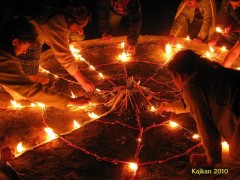
Hundreds of Mayans have gathered to celebrate Mayan New Year at the archaeological centre of Iximche in Guatemala.
At a religious ceremony, indigenous Mayan people placed candles on an ancient Mayan altar, symbolizing a message of peace and hope they send to humanity.
Wednesday also marks the start of the countdown to 21 December 2012 – the day marked in the Mayan calendar as the start of a new era, or cycle.
Each cycle lasts approximately 5,125 years. The Mayan calendar identifies the end of one era as the beginning of an equally long one. Sacred literature never at any times speaks about the end of the world, a catastrophe or apocalypse.
On the contrary, this is a new era of hope.
Source:http://english.cntv.cn/program/newsupdate/20120223/115750.shtml
Spanish version. Versión traducida al Español
Guatemala Celebra el Año Nuevo Maya
23 de Febrero de 2012.
Cientos de Mayas se reunieron para celebrar el Nuevo Año Maya en el centro arqueológico de Iximché, Guatemala.
En la ceremonia religiosa, los indígenas Mayas colocaron candelas sobre un antiguo altar Maya, simbolizando un mensaje de paz y esperanza que ellos envían a la humanidad.
El miércoles también marca el comienzo de la cuenta regresiva hacia el 21 de Diciembre de 2012- que es el día marcado en el calendario Maya como el comienzo de una nueva era o ciclo.
Cada ciclo dura aproximadamente 5,125 años. El calendario Maya identifica el fin de una era como el comienzo de una igualmente larga. La literatura sagrada en ningún momento hace referencia al fin del mundo, de una catástrofe o del apocalipsis.
Al contrario, esta es una nueva era de esperanza.
Fuente:http://english.cntv.cn/program/newsupdate/20120223/115750.shtml
By: Ligia María
Original version, Spanish translation below

Traducción al Español, abajo
Monday, 09 January 2012
Guatemala, Rethaluleu, Asintal. Takálik Ab´aj. Discovery of the necklace of the ancestor of the Mayan- Señor de la Greca – Lord of the Fret Design, the Return to the ancestor at Tak’alik Ab’aj. This is the latest finding at the ancient city of Tak’alik Ab’aj. Tak’alik Ab’aj fulfilled for almost two millenniums, a rich and vigorous role in Mesoamerican history.
The sculptured monuments buried there through the centuries, whose tops still emerge from the ground, gave way to the name, which in the K’iche’ language means Standing Stone. Tak’alik Ab’aj is an ancient pre-Hispanic city situated in El Asintal, Department of Retalhuleu at the pacific piedmont of Guatemala. This important long distance trade and cosmopolitan cultural center is transcendent because of its long history which endured 1700 years (800 B.C. – 900 A.D). At its beginnings Tak’alik Ab’aj interacted and participated with the Olmec culture, and at its surmise, was one of the protagonists in the development of the early Maya culture.
Deep inside Structure 6, one of the most important ceremonial buildings of the Central Group at Tak’alik Ab’aj, in 2011 the team of the National Archaeological Park Tak’alik Ab’aj, lead by archaeologists Christa Schieber de Lavarreda and Miguel Orrego Corzo of the Guatemalan head office for Cultural and Natural Heritage, Ministry of Culture and Sports, concluded with the excavation of a very special offering yielding a necklace of more than 70 beads of jadeite of different forms and outstanding beauty. This “Necklace offering” is situated more than 4 m at the bottom of the building and was deposited there between 190 b.C. and 10 a.D. (Late Preclassic); it is the most ancient of a series of ritual acts succeeding each other through centuries orbiting around one same vertical axis. This sequence of extraordinary offerings apparently corresponds to dedication rituals to the different architectonic versions from Late Preclassic to Early Classic.
Meeting Point: About Media and Democracy in Guatemala
By: Ligia María
Original version, Spanish translation below

Traducción al Español, abajo
By MARIELOS MONZÓN
February 15, 2012
In the process of building democracy there are certain fundamental factors which cannot be eschewed. One of these factors has to do with a real possibility of citizens to experience a diverse media that permits distinct perspectives and the plurality of information and analysis. Control of the media’s agenda, in which there’s only one form of viewing and approaching the world, contradicts essential rights such as, communication and freedom of expression.
The democratization of mass media guarantees equal opportunity in the right to its use and access, including those radio frequencies in which the State has permitted usufruct from private citizens. Since the General Telecommunication Law’s enactment in 1996 the only way to gain access to a radio or television frequency is the auction, contradicting the State’s obligation of guaranteeing equal access to frequencies and creating a barrier on those sectors of the population that don’t count with the financial resources to compete in against corporations in the bidding process.
In 1995 the Accords on Indigenous Peoples Rights and Identity was signed. In the section which refers to Cultural Rights a compromise is established to promote before Congress the reforms necessary to “facilitate radio frequencies for Indigenous projects and to assure the observance of the non-discrimination principle in the usage of media”, as well the repeal of all legal order which enables the “obstruction of Indigenous Peoples rights to dispose of media for the development of their identity”
The Telecommunications law, approved a year after the accord was signed, contradicts the latter’s content thus practically invalidating the agreement. For that reason, the National Community Media Movement of Guatemala, bringing together around 80 community radio stations, and the Mayan Organization Council of Guatemala (COMG) presented an appeal for partial unconstitutionality against the Telecommunications law, looking to guarantee equality in the access of radio frequencies.
In Pictures: Community Radio Station “Xilotepek”
By: Ligia María
Original version, Spanish translation below

Traducción al Español, abajo
February 21, 2012
San Luis Jilotepeque is a town in the department of Jalapa, located on the southeast of Guatemala. It is a community where two cultures meet- the mestizo population with the Poqomam Maya. According to history, the Poqomam people were divided by the Spanish during the time of the invasion, which explains why today the Poqomam people are found in different pockets of central and southern Guatemala.
A group of neighbors joined together in 2009 to form the community radio radio station Xilotepek Stereo. Together they drew up a list of objectives for a radio station: “to use communication to promote the community participation in town-wide decisions, by informing, educating, and promoting human values and equality,” explained Victor Sanchez, the station’s director.
Since 2009, the station has been broadcasting town-wide social events, cultural celebrations, politics, and local sports, with live coverage on location. The station also broadcasts local and national music, hosts interviews, and runs programming on customs and traditions of the community of San Luis Jilotepeque.
Volunteers of the station include youth, adults, and elderly members of the community, all of whom have been eager to participate. The station has been a member of Cultural Survival’s pilot radio program since last year, where they are learning more about community communication and hoping to be able to expand the content of their programming.
Cesar Gomez (pictured right) and other Cultural Survival Staff visited with radio director Victor Sanchez in February 2012. Both Cesar and Victor speak Pocomam, one of the minority Mayan languages which exists only in small pockets across the country. The low watt radio tower over the station and a young volunteer broadcasts inside the radio cabin.
Source: http://www.culturalsurvival.org/news/pictures-community-radio-station-xilotepek

Spanish version. Versión traducida al Español
Estación de Radio Comunitaria “Xilotepek”
21 de Febrero de 2012
San Luis Jilotepeque es un municipio de Jalapa, localizado al sudeste de Guatemala. Es una comunidad donde se encuentran dos culturas , la población mestiza y la Maya Poqomam. De acuerdo con la historia, los Poqomames fueron divididos por los españoles durante la invasión, lo que explica por qué hoy día los Poqomames se encuentran en diferentes lugares del centro y del sur de Guatemala.
Un grupo de vecinos se unió en 2009 para formar la estación de radio comunitaria Xilotepek estéreo. Juntos elaboraron una lista de objetivos para la estación de radio: “usar la comunicación para promover la participación comunitaria en todas las decisiones , informando, educando, y promoviendo los valores humanos y la igualdad,” explicó Victor Sanchez, el director de la estación.
Desde 2009, la estación ha radiotransmitido todos los eventos sociales de la comunidad, celebraciones culturales, políticas y deportivas, con cobertura en vivo. La estación también radiotransmite música, entrevistas, y programación de las costumbres y tradiciones de la comunidad de San Luis Jilotepeque.
La estación tiene como voluntarios a jóvenes, adultos y ancianos, todos ellos miembros de la comunidad quienes participan con mucho entusiasmo.
La estación es miembro del programa piloto de radio de Supervivencia Cultural desde el año pasado, donde están aprendiendo más acerca de la comunicación comunitaria y esperan poder expandir el contenido de su programación.
Cesar Gomez (derecha) y otros miembros de Supervivencia Cultural visitaron al director de la radio Victor Sanchez en Febrero de 2012. Los dos, Cesar y Victor hablan Pocomam, una de las lenguas Mayas minoritarias que se habla en muy pocos lugares en todo el país.
Fuente: http://www.culturalsurvival.org/news/pictures-community-radio-station-xilotepek
By: Ligia María
Original version, Spanish translation below
Traducción al Español, abajo
February 21, 2012
On the last weekend in January 2012, Cultural Survival’s partner network of pilot radio stations gathered together once again in San Mateo, Quetzaltenango to participate in a workshop about the Mayan calendar and spirituality. Cultural Survival invited representatives of twenty different radio community stations to learn about the meanings behind the K’iche Maya solar calendar from two Mayan spiritual guides from the town of Momostenango, Totonicpan, who addressed in detail what the 2012 change means for the Mayans. Anselmo Xunic, manager of the Radio Project, explained to participants, “It’s important to make clear to our listener audiences what the closing of this cycle in 2012 really means, since the information has been so manipulated. As Mayans, and members of this ethnicity, it is our duty to understand.”
The workshop took place in the Mujb’ab’l Yol Community Training center. Mujb’ab’l Yol, an association of radio stations in the highland area of Guatemala, has been working on the construction of the center over the past 3 years. Slowly but surely, the center has been coming to life. This workshop was the first to be held after the new installation of bathrooms and a fresh coat of paint on the walls, thanks to local fundraising by the Mujb’ab’l Yol Association. Community radio station Doble Via, which was previously located down the road from the center, is now broadcasting from within the center.

Spanish version. Versión traducida al Español
Voluntarios de las radios comunitarias Participan en Taller sobre Espiritualidad Indígena
21 de Febrero de 2012.
Durante el último fin de semana de enero de 2012, el grupo de Supervivencia cultural se reunió una vez más con la red de estaciones de radio piloto en San Mateo, Quetzaltenango para participar en un taller acerca del Calendario y la Espiritualidad Maya. Supervivencia cultural invitó a representantes de 20 diversas estaciones de radios comunitarias para aprender acerca del significado del calendario solar Maya K’iche el taller contó con la participación de dos guías espirituales Mayas de la comunidad de Momostenango,Totonicapan, quienes hablaron en detalle acerca de lo que el cambio del 2012 significa para los Mayas. Anselmo Xunic, administrador del proyecto de radio, explicó a los participantes, “es importante aclarar a la audiencia que nos escucha lo que significa realmente la culminación de este ciclo en el 2012, ya que la información ha sido bastante manipulada. Como Mayas, y miembros de esta etnicidad, es nuestro deber entenderlo perfectamente.”
El taller se llevó a cabo en el Centro de formación comunitario Mujb’ab’l Yol. Mujb’ab’l Yol, es una asociación de estaciones de radio en el área alta de Guatemala, ha estado trabajando en la construcción del centro en los pasados 3 años . Lento pero seguro, el centro ha comenzado a funcionar. Este taller fue el primero en llevarse a cabo después de la instalación de baños y pintar las paredes, gracias a los fondos recaudados localmente por la asociación Mujb’ab’l Yol. La estación de radio comunitaria Doble vía, que se encontraba previamente en el camino del centro, transmite ahora desde el centro.
Guatemalan Mayans take fight to the airwaves
By: Ligia María
Original version, Spanish translation below

Traducción al Español, abajo
Posted: Friday, January 27, 2012 –
By James Fredrick
The Guatemalan government is cracking down on the country’s hundreds of pirate radio stations. Indigenous leaders say the 1996 Peace Accords give them the right to broadcast.
SUMPANGO, Guatemala – The dial is tuned to Radio Ixchel, 102.3 FM. Rosario Sul González is signing off her show: “I just want to remind all of you today to keep smiling, because a smile is the key that can open any door, even the door of hate. Let’s not forget that.”
Turn the dial to 99.7 Kiss FM, and they’re on commercial. A spot features two men speaking: “Juancho, what’s up man?” asks one of the men. “Well, I’m worried, … they’re shutting down all the pirate radio stations,” Juancho replies.
“Well, of course, Juancho, those are against the law,” Juancho’s friend says. “Don’t tell me you have one! But you seem so respectable. Hurry up and close it. Or would you rather I come visit you in jail?”
The figurative Juancho in the fictional conversation is a radio pirate. Rosario, an energetic 28-year-old Mayan communications student, is a real one. In Guatemala, where there are 15 murders per day and only 2 percent of them are solved, constant warnings about radio piracy seem amiss.
Rosario broadcasts for her local Radio Ixchel in her free time. She sits in a bare nine-square-meter room with two small tables, a mixing board, one computer and two microphones. The main door is unmarked.
Native People Suffer Racism in Employment
By: Ligia María
Original version, Spanish translation below
Traducción al Español, abajo
By Danilo Valladares
GUATEMALA CITY, Jan 2, 2012 (IPS) – “There’s a big difference in the way indigenous people and mestizos (people of mixed ancestry) are treated. We are not paid the same wages for the same work,” Higinio Pu, an activist with the native group Waxaquib Noj, which means “wisdom” in the Maya Quiché language, told IPS.
“When workers are hired we are also passed over. And indigenous women who work in the ‘maquilas’ (plants assembling goods for export) are hit especially hard by discrimination,” said Pu.
These views were corroborated by a survey on “Racismo y discriminación racial en el sector empresarial” (Racism and racial discrimination in the business sector), carried out in November by the Association for Research and Social Studies (ASIES), an NGO, and the Presidential Commission on Discrimination and Racism Against Indigenous Peoples in Guatemala (CODISRA).
Based on telephone interviews with 550 business owners in greater Guatemala City, the survey found that on average, only 12 percent of workers in small and micro-enterprises are indigenous people, while the workforce of medium and large businesses is made up of 20 percent native people.
According to official statistics, indigenous people comprise close to 40 percent of Guatemala’s population of 14 million, but native organisations put the figure at over 60 percent.
Guatemala: Indigenous women are the poorest of the poor
By: Ligia María
Original version, Spanish translation below
Traducción al Español, abajo
By Martin Barillas
Monday, November 14, 2011 “Creating Opportunities” is a program launched by the Population Council, a U.S.-based nongovernment organization in the Guatemalan provinces of Alta Verapaz, Chimaltenango, Sololá, Totonicapán, Quetzaltenango and Chiquimula, and addressed to girls between 8 and 18 years of age, with the objective of strengthening rural communities and creating “safe spaces” where they can come together and develop their self-esteem, skills, and plan the future.
Launched in 2004, the program wants to break the cycle of poverty and make the girls realize their full potential. In Guatemala in fact, where 14 million people live, half of them in poverty, indigenous women are the poorest of the poor, and live marginalization and discrimination.
According to official statistics, 40% of the country’s population consists of indigenous, even if native groups and international NGOs argue that they are 60%. Among women there are 7 out of 10 maternal deaths, the highest teen pregnancy rate in rural areas of Latin America, with 114 mothers who are less than 20 per 1000 births. Only 26% of indigenous women who speak the native languages complete primary school, compared to 45% of boys and 62% of indigenous women who speak Spanish.
According to the Population Council, Mayan girls are the most disadvantaged in the country, subject to early marriage, limited education, frequent pregnancies, social exclusion and chronic poverty. In addition, according to the recent report of The State of the World Population 2011, United Nations Fund for Population Activities (UNFPA), Guatemala has the highest fertility rate in Latin America. Guatemalan women between 15 and 49 have an average of 3.8 children, compared to the average of 2.2 across Latin America.
Source: http://www.speroforum.com/a/MNOLNYYNTG27/Guatemala-Indigenous-women-are-the-poorest-of-the-poor
Spanish version. Versión traducida al Español
Guatemala: Las mujeres indígenas son las más pobres entre los pobres.
Lunes 14 de Noviembre de 2011. “Creando oportunidades” es un programa emprendido por el concejo de población, una organización no gubernamental con base en estados Unidos en las provincias guatemaltecas de Alta Verapaz, Chimaltenango, Sololá, Totonicapán, Quetzaltenango y Chiquimula, dirigido a muchachas entre 8 y 18 años de edad, con el objetivo de fortalecer las comunidades rurales y crear “espacios seguros” donde se puedan reunir y desarrollar su auto-estima, destrezas, y planear su futuro.
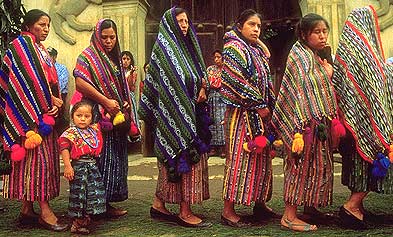
Traducida al Español, versión original arriba
Comenzando en el 2004, este programa quiere romper el ciclo de pobreza y hacer que las jovencitas se den cuenta de su potencial. De hecho en Guatemala, donde viven 14 millones de personas, la mitad de ellas en la pobreza, son las mujeres indígenas las más pobres entre los pobres, viven la marginalización y discriminación.
De acuerdo con estadísticas oficiales, el 40% de la población del país es indígena, aunque grupos nativos y ONGS argumentan que conforman el 60%. Entre las mujeres hay siete de cada diez muertes maternales, la taza más alta de embarazos en adolescentes en Latinoamérica. Sólo el 26% de mujeres indígenas que hablan la lengua nativa completan la escuela primaria, en comparación con el 45% de los varones y el 62% de mujeres indígenas que hablan español.
De acuerdo con el concejo de población, las jóvenes Mayas son las más desfavorecidas en el país, sujetas a matrimonios prematuros, educación limitada, embarazos frecuentes, exclusión social y pobreza crónica. Adicionalmente, de acuerdo con el reciente reporte de El Estado de la población mundial 2011, Fondo de las naciones Unidas para actividades poblacionales (UNFPA) , Guatemala tiene el porcentaje más alto de fertilidad en Latinoamérica. Las mujeres guatemaltecas entre los 15 y 49 años tienen un promedio de 3.8 hijos en comparación con el promedio de 2.2 en el resto de Latinoamérica.
Fuente: http://www.speroforum.com/a/MNOLNYYNTG27/Guatemala-Indigenous-women-are-the-poorest-of-the-poor
Indigenous victims still await compensation
By: Ligia María
Original version, Spanish translation below
Traducción al Español, abajo
By Louisa Reynolds
Government apologizes for human rights violations during armed conflict while compensation programs for victims are severely underfunded.
Carlos Chen Osorio is the only survivor of a Mayan Achí family whose members were brutally slaughtered by the army in five different massacres perpetrated during Guatemala´s 36-year-long civil war against the inhabitants of Río Negro, a town in the northeastern department of Baja Verapaz.
Chen lost 40 family members and today he leads the Association for the Integral Development of Mayan Achí Victims of Violence, an indigenous organization based in Baja Verapaz that seeks compensation for war victims.
According to Chen, symbolic actions taken by the government, such as public admissions that the State applied genocidal policies against the country´s Mayan communities, are not enough.
“The government has apologized for what was done to us but apologies won´t buy us land or a home,” he said.
President Álvaro Colom is the nephew of Manuel Colom Argueta, former mayor of Guatemala City, murdered at the height of the military repression in 1979, and his center-left administration has sought to portray itself as the heir of the 1944 Revolution, an uprising against dictator Jorge Ubico that ushered in a decade of democratic rule under Presidents Juan José Arévalo and Jacobo Árbenz.
From the Field: Opening Horizons for Guatemala’s Girls
By: Ligia María
Original version, Spanish translation below
Traducción al Español abajo
By: Talea Miller
February 9, 2011. ANTIGUA, Guatemala– For girls living in the rural, indigenous communities of Guatemala, it is not unusual to leave school by the age of 12, be married by 15, and give birth for the first time while still a teenager.
About 60 percent of school-aged children complete primary education in Guatemala, according to UNICEF, and the rates are far lower in indigenous communities.
The traditional role of a subservient wife, who works inside the home, is still the standard in most rural areas. But women in Guatemala also face widespread gender-based violence, from spouses and family members and through brutal attacks by the gangs that plague the country.
Within this environment, the U.S.-based nonprofit Population Council has created Abriendo Oportunidades, or Creating Opportunities, as a support system for Mayan girls. Using mentoring, the group teaches teens about preventing and responding to gender-based violence. Mentors also support girls who want to continue their education and make a living. There are about 3,000 women involved in the network.
“Every extra year in school is a gain, every year marriage is delayed is a gain,” said Alejandra Colom Bickford, coordinator of the Population Council’s programs in Guatemala.
During a week-long workshop in Antigua, women in the network talked about the challenges they face in their own lives, and the messages they want to spread as mentors:
 Mariela, 20, was attacked and raped by a man in her home village of Coban while she was pregnant with her now month-old daughter. She never reported the attack because she was scared people would judge her for what happened and that the man would come after her again.
 Maya News